Wow, it’s been a while since I’ve posted here! I’ve been collecting some material for a book on computer-aided puzzle construction and publishing. I’ll get around to the book eventually, but some of the material probably has a relatively short shelf life, so I thought it would be good to put some of it in blog form, so here we are!
Since creating the Krazydad Discord community, a few months ago, I’ve had lots of great conversations with budding puzzle constructors and publishers. Several times I’ve had conversations about publishing puzzle books, and I often find myself sharing similar tips. I’ll share a few of them here.
My number one tip, if you are planning on self publishing puzzles is: don’t quit your day job! Puzzle publishing is something I do mostly for fun, and while I make a little money at it, it is definitely not enough to live on! In general, my impression is that the few individuals who are making a “full time living” at puzzles are not actually doing a whole lot of puzzle construction. They are “puzzle business” people, more so than puzzle making enthusiasts.
My second tip is to spend a little time educating yourself about book design and typography. I am not a designer, and especially not a book designer. But I have read a lot of books, and I can spot the difference between a book with shoddy design and good design. So can you, I imagine! As a budding publisher, it made sense to educate myself. I did this by purchasing, and reading cover-to-cover a few books on the subject. Some of the books I originally read on this topic years ago are now long out of print, but still super interesting (they include The Design of Books by Adrian Wilson, and Graphic Design for the Electronic Age by Jan White). There are definitely newer and much better books on the topic, but also, there’s nothing wrong with an out-of-print typography book! The basic principles of classic Typography and Book Design were as true in the late 19th century as they are now, so if you see an interesting looking book in a used bookstore, go for it! I also enjoyed the more recent Butterrick’s Practical Typography by Matthew Butterick (which you can read online for free!).
I have occasionally purchased self-published puzzle books (generally on Amazon) that commit a variety of sins. Most of these sins are invisible to the authors since they are ignorant of these details, but they may have a nagging suspicion that their book isn’t as nice as a professionally designed book.
These sins include:
1. Filling the page with as much text as possible, at the expense of readability. Lack of white space. Don’t let your desire to minimize the page-count (a cost issue) diminish the quality of your book.
2. Inconsistent padding and margins throughout the book, as if I am essentially reading a printed-out MS Word document (which is too often the case).
3. Too-narrow margins on the left and right sides of the pages, also at the expense of readability.
4. Failure to adjust for the difference between recto and verso pages (such as having wider inner margins).
5. Consistent use of “straight” quotes instead of “curly” quotes.
6. Poor font choices. I don’t recommend using system fonts like Comic Sans and Arial, intended primarily for screen display, for your entire book.
7. Misspellings (I’ve done this myself, fortunately these are easy to fix when you use print-on-demand!)
Ultimately, I would prefer it if my books look like they were typeset by hand, by Baroque monks, with custom drop-caps on each chapter, gold-tipped bindings, and beautiful multi-colored marginalia. I am not there yet, but that’s the dream. Every time I publish a new series, I get a tiny bit closer to that elusive goal.
If high quality design is also your dream, you should not be typesetting your book by preparing the document in Microsoft Word (or Google Docs or Apple Pages) or any word-processor that is more suitable for business correspondence, and instead you should be using desktop publishing software. I used to use Scribus (free) for this purpose, and I now use Affinity Publisher II (cheap). They are both great, but I find Affinity’s software a bit easier to use. The one-time cost of this software is well worth the increased layout control and potential improvement it will give to the look of your pages. There are other good options that I haven’t tried, like Adobe InDesign and QuarkXPress.
I have a few things to say about the differences between print-on-demand on Amazon versus traditional publishing versus other forms of self-publishing, which I’ll leave to a follow-up post. If you have questions for me, feel free to put them in the comments!
Permalink|Comments Off on Self publishing tips, Part 1
NOTE: This post was edited Jan 2nd, to reflect a modification to the settings.
If you are doing the interactive puzzles on the puzzle website, you have probably noticed that when you complete a puzzle, instead of getting a pithy quote, you get an illustration (often, but not always, of a hedgehog, sometimes a kitty with wings, sometimes a lady driving a chariot pulled by cats, sometimes a forest, that kind of thing). I made all the illustrations using a fun tool called Midjourney that allows me to imagine things and make pictures of them. There are currently some five dozen pictures, and I’ll be adding more periodically.
If you miss the pithy quotes, and you hate the pictures of hedgehogs and trees, you can go back to the old system. Just select the setting icon (the gear) below the puzzle, and turn on “Quotes” instead of “Pics”, as shown to the right. You can also use the “Both” setting, which will randomly alternate between quotes and pictures (using a simple coin-flip).
Why did I switch to pictures, you ask? Well there are two reasons. #1 The pictures are kinda cool. #2 I have occasionally been asked to turn the quotes off, especially by school teachers. The problem is that my quote database is very large, consisting of some 30,000 quotes I’ve acquired from various public-domain sources over the years. Unfortunately, a small handful of the quotes are a little too spicy for school kids. There are also a few downright misogynist (or otherwise problematic) quotes in there as well that date from the 80s and 90s (back when many of these quotes were compiled by computer nerds). When I hear about them, I remove them, but my attention-deficit disorder prevents me from reading every single quote, and I simply don’t know what’s in there!
In the past month I’ve published four puzzle books, you can read about them here.
It is no secret that the puzzles in my books are produced using computer software that I write. I’ve been writing such software for nearly twenty years. I’ve spent a lot of time working on that software, and I’m proud of the high quality puzzles it produces.
What is new this month, is that my most recent book, A Panoply of Puzzles, is illustrated. The chapter introductions make use of a dozen pen and ink illustrations of hedgehogs, not to mention the front cover. And the illustrations were, in fact, also generated with the aid of a computer. I used a service called Midjourney, which, if I may say so, did an excellent job with the illustrations!
If you can imagine it, and if Midjourney has seen enough of it, then it can do a pretty creditable job of drawing it, in a variety of styles. I’m kind of partial to classic pen & ink style illustration, so that’s what I used. I’ve found that Midjourney has seen a LOT of hedgehogs, not to mention kittens and violins.
Sadly, Midjourney has not seen enough hurdy-gurdies (one of my other interests) so I can’t use it to illustrate any forthcoming hurdy-gurdy books. But hedgehogs? Wow! can I make a lot of hedgehogs!
Like a kitten with wings, I am very happy with these new super powers, and I look forward to including more illustrations in my future books!
Permalink|Comments Off on A Panoply of Puzzle Books
When I was still going to CalArts in the early to mid 1980s, I parlayed my recently acquired BASIC programming skills (via a Timex Sinclair 1000) into a part time job at a little mom-and-pop company in Granada Hills.
The company did chemical recycling. They would buy used or surplus chemicals, such as industrial solvents, or glycerine, and resell them to buyers (often cosmetics companies looking to save a buck). The couple who ran it were really nice, and desperately needed technical help. I was in my early 20s, had few technical skills, but knew how to figure things out.
The job was ostensibly to create and maintain a database of chemicals, on an Altos “minicomputer” with a few dumb terminals running MP/M. I learned dBase II on the job (it was the second computer language I gained any proficiency in, and perhaps the only one versioned in roman numerals). All my learning came from a handful of books and a lot of trial and error.
This was my first job that paid more than minimum wage (not much more, but enough to realize that I was going to be more successful as a programmer than a musician), and it gave me access to several computers (including an original IBM PC), a phone line, and a 1200 baud Hayes modem. I tended to “work” in the late evenings and spent an enormous amount of time abusing the privilege.
Fairly early on, I wrote a “war dialer” in BASIC, which would sequentially dial thousands of the local phone numbers, listening for the telltale code that indicated a modem had answered the phone, recording the “hits” to a text file.
There were more modems connected to phone lines in those days, but still not many (maybe 1 for every 300 numbers tried). If I left the modem’s speaker on, I could hear a series of answering machine messages, annoyed people answering “Hello?” at 2am, and lots of ringing phones which didn’t pick up at all.
I was aware that this activity was probably illegal, and I took a few steps to cover my tracks. I only called local numbers, so as not to leave a record on the company phone bill, and I scrambled the order of the numbers I dialed, instead of dialing them in sequence (I have no idea if this helped evade detection, but the activity didn’t last long and I never got busted for it).
After the War Dialer ran all night, I would come in the next day and try dialing into the newly acquired modem numbers myself, to see what treasures lay on the other side of the line. Several systems had login prompts, and some of them identified themselves and provided useful help systems.
I remember getting excited when a local hospital provided a helpful staff directory, giving me a list of potential accounts to log into.
But I didn’t get very far. Breaking into other computers was never my primary hobby. Everything about computers was fascinating and I dabbled in a lot of things, but I mostly liked programming itself.
One of the nice things about doing technical work in a place with few technical people, is that your screen was generally filled with unreadable gibberish, and it was not at all obvious what you were actually doing. As long as I was programming, it looked like I was working, even though I could be programming something completely unrelated to the job at hand, such as a war dialer.
It is perhaps worth mentioning, in case any future or current employers are reading this, that this was a very long time ago. I am now an elderly graybeard programmer and have matured ever-so-slightly.
I got my friend Kevin a job there, and we spent a lot of time dialing into the local BBSes in the 818, which were flourishing. We also ran our own BBS, The Phantom, for a time, during the evening hours, and would chat with the people who dialed in. We would arrive at the office at 8pm and hop BBSes til 6 or 7 in the morning, doing the occasional run to the local Carls for burgers and Monterey chicken sandwiches.
In Los Angeles the 818 and 213 BBSes were numerous and varied. I remember a lot of FidoNet and Wildcat systems. Our BBS, The Phantom, was a RBBS-PC systems which was programmed in BASIC. I remember attending a local RBBS user group and meeting other BBS operators. It was a community dominated by bored white guys who would have been into Ham Radio in another decade (not dissimilar to the Hurdy Gurdy players and Airplane enthusiasts I currently commune with, honestly).
We used our BBS to publish freeware that we wrote (often in CP/M WordStar), hoping to seed it to other BBSes. Most of my offerings were arts-related and probably never had an audience of more than ten people. I remember writing a BASIC program called “FakeBach” that emitted pleasant(?) computer-generated melodies until you hit Control-C, and a simple ecosystem simulation of sheep and daisies in a meadow (very much influenced by A.K. Dewdney’s Wa-Tor column in Scientific American).
Kevin, more technically polished than I, experimented with Small C, one of the first free C language implementations available to us (I didn’t learn C until a few years later — it rapidly outpaced BASIC and became the dominant PC language by the late 80s). Kevin also made his own Forth clone which he called “OrthFay”, a naming idea I later stole for my language “iptScray”.
We copied and hosted freeware from other BBSes that we liked, and we chatted (typed) with the occasional caller, if we happened to be around.
A few nascent BBBes were exploring new ways of selling things in the mid 80s. There was an online shopping mall in Covina called The Citadel (1984-1992), which was a bit like a text adventure set in a deserted Glendale Galleria.
These dialup systems were limited by the number of incoming phone lines they could handle, which was generally less than 10, so the Citadel was never going to rival Amazon.
One of my favorite late night haunts was an oddball 213 BBS called PatVac, run by an apparent eccentric named Harris Boldt Edelman, who was a kind of software satirist. I remember his parody version of WordStar, called WordTard, which had a bunch of oddball menu options, and would inject random characters into your documents. I just looked up Harris and found his occupation is (or was) listed as “Atavistic Desuetism”.
The Phantom only survived a year (1985). The BBS heyday lasted just a few years, eventually BBSes were subsumed by the various online services that were cropping up, soon to be followed by the consumer Internet. While BBSes continued well into the 90s, I had stopped using them by 1989 or so. By the mid-90s, a war dialer was much more likely to encounter fax machines than dial-up systems.
Over the course of the Pandemic, I’ve purchased a LOT of puzzle books, and I thought I’d review some of the better ones over the next few blog posts. First up is one of my favorites, Montague Island Mysteries by Wayne Schmittberger.
I picked up this book because I’m a fan of old fashioned logic puzzles, also called “Einstein’s puzzle” or “Zebra Puzzles”. The kind where there is scenario involving groups of things that are connected in some way. For example, there might be a group of girl scouts, each of whom ate a different flavor of ice-cream, and each of whom has a different merit badge, has a different pet, participated in a relay-race and you have to figure out, from a limited set of clues, who ate what, who wore what, who petted what, and who won the race.
This puzzle is traditionally called a “logic puzzle”, but the term precedes the popularization of other kinds of puzzles that involve logic, including Sudoku, Kakuro, Star Battle, Slitherlink, Battleship Solitaire, and pretty much every puzzle on my website. So, for clarity, I prefer to call this specific variety a “verbal logic puzzle”, to distinguish them from the other kinds puzzles that employ logic.
I don’t actually publish verbal logic puzzles at Krazydad (for reasons I explain here), but I very much enjoy solving them. There are other publishers that publish them, including Puzzle Baron, and you can buy them in various supermarket and drugstore magazines published by Dell/Pennypress.
Everett Kaser has also published a series of games which use this format, which I find delightful. I have purchased all of his iPad games and several of his desktop games.
Most of these publishers tend to publish a fairly straightforward form of this puzzle, in that there is one of everything. In other words, if there are five girl scouts, then there are also five unique flavors of ice-cream, five unique sweaters, five unique merit badges and so on. These puzzles can be typically be solved on a grid which lays out all the item’s interactions, using basic inferences and the process of elimination. The puzzle is typically accompanied by a grid, like the one on the left.
If you are a fan of more challenging puzzles, like me, then I think you will really like the Montague Island books.
These books start with that basic logic template, but take it into a lot of interesting and new areas. Each book has one or two puzzles of the basic grid type, as described above, but all the other puzzles introduce various twists on the formula which increase the level of difficulty. These twists include the introduction of potentially false statements, the sharing of items (e.g. two or more people might like the same flavor of ice cream), the use of spatial reasoning, such as the layout of the house or the distances between points-of-interest on the island, poker hands, and more. Several of the puzzles can’t really be solved using a traditional grid and require that you find a better way to diagram the statements.
Another thing I love about these books is the thematic cohesion: Each book has a story which runs through the book, and the puzzles involve the same people. In the first book, seven guests are visiting a mansion at Montague Island over a series of consecutive weekends to solve a series of mystery puzzles. The hosts (Gordon and Nina), the household staff (Alistair, Evelyn, Lyle, Molly, Nolan, Sandy), and the guests (Beth, Charles, David, Frank, Jessica, Karen, Taylor) all conveniently have names which start with a different letter within their groups, which is useful for note taking (you’ll want to to take notes, trust me). The theme of the books resembles a classic Agatha Christie book, and provides a measure of cosy mystery, which adds to the fun.
Borrowing liberally from the whodunnit genre, many of the puzzles require you to solve a crime or murder, and require you to identify the perpetrators from a list of the seven guests. The clues come in the form of statements from the hosts, the household staff, and the guests. In these scenarios, the perpetrators of the crime may or may not be lying, and of course, you don’t know who is lying!
The author of the Montague Island series is R. Wayne Schmittberger, who edited Games Magazine for many years before retiring. As a former editor, Schmittberger clearly has the attention to detail needed to construct these puzzles and he provides extremely detailed explanations of the solutions with virtually no errors. Judging from the variety of the puzzles, it’s abundantly clear that these puzzles were constructed by hand (unlike, say, the puzzles on my website or the Puzzle Baron books). Hand construction means greater variety in puzzle construction, but also means there is greater opportunity for human error (especially with puzzles as intricate as these) and I did spot a single error, which I reported to the publisher (I’m told it may have already been fixed in a later printing).
These are large books (8.5″ x 11″), published with a “lay flat” coil binding on non-glossy paper which takes pencil well. I wish more puzzle books were printed with coil bindings (and that it was more economical for me to do so with my own books)!
The first book has 40 puzzles, each of which took me at least several hours (and in some cases, a couple days) to solve. This speaks to the difficulty of the puzzles — a traditional logic puzzle generally takes me about 20-30 minutes, give or take.
I am currently midway through the second book in this series (there are currently four volumes, the most recent being published in December of 2021. I have found the puzzles in the second book to be a bit harder than book 1, and the difficulty cadence to be a little more random than in the first book, which starts easier and gets harder.
I look forward to eventually getting through all the books in this series, as there are very few (or no?) other books which hit the same “sweet spot” of having a wide variety of verbal logic puzzles and that lovely cosy thematic cohesion. I hope Schmittberger’s choices ultimately influence other puzzle authors, and we see more books that exhibit these great qualities.
Permalink|Comments Off on Montague Island Mysteries book review
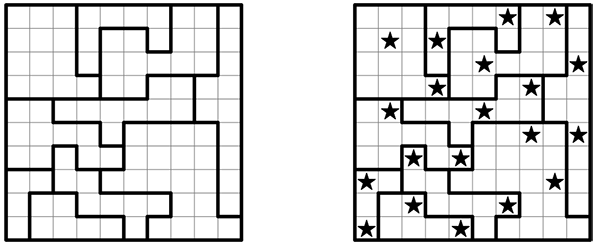
Diabolical Two Not Touch is the latest addition to my Star Battle puzzle offerings on Amazon.
My original Two Not Touch book series contains puzzles which start at the same difficulty as my puzzles in The New York Times and then get increasingly more difficult. The three new diabolical books start where the previous books leave off, and continue raising the difficulty considerably higher.
Note that all of the puzzles in my Star Battle books can be solved without resorting to trial and error. This is not necessarily true of the free Star Battle puzzles published on my website, particular in the books numbered from 50 through 100. I originally included many puzzles I can not personally solve without trial and error as a way for me and others to help identify new solving strategies. Because of this, I find that many people start to really struggle around book # 45. In my new books, you will struggle, but you should never have to resort to guesswork. If a particular puzzle is stumping you, send me a snapshot showing your work in progress, and I’ll be happy to help you out.
These are challenging times we are living in, and I hope that these puzzles can provide you a healthy escape!
Your book purchases (and Amazon reviews) help pay for the costs of running my free website. Thank you so much for your support!
Permalink|Comments Off on Diabolical Two Not Touch
My name is Phil, and I’m going to be talking about a spooky new puzzle type in a moment, but I thought I’d take a moment to introduce myself first. You may have seen my name already associated with a couple of recentadditions to the Krazydad oeuvre; after being in contact with Jim off and on over the course of a few years, helping a bit here and there with new puzzle types, our benevolent site-runner brought me on board earlier this year to help in a more official manner. Most of my work before this point was on behind-the-scenes stuff you aren’t likely to notice–improved page load speed, backend systems work, that sort of thing–but I led a lot of the work on this new puzzle type, and you’ll be seeing more of my efforts in the months and (hopefully) years to come, so I thought it was well past time to say hello.
If you have any questions about my credentials when it comes to puzzles, let me give you the briefest of anecdotes. When I was a wee lad, I had exactly two prized possessions. One was a copy of The Official Nintendo Player’s Guide:
My copy was much, much more beat up than this one.
…and the other was a big brown bag, nearly as large as my diminutive frame, chock-full of puzzle magazines from Dell and Penny Press that I had successfully wheedled family into buying me almost every time we went to the grocery store or corner shop. My mother threw away the contents of that bag in the mid-’90s, and if I’m perfectly honest I still haven’t quite forgiven her for that. (Or for the destruction of one of my 5.25″ floppies for Pool of Radiance, but that’s another story entirely…)
I miss their old tagline: Penny Press means Puzzle Pleasure!
But entirely too much about me. You’re here for the puzzles, right? And we’ve got an exciting new one for you:
See, I told you it was spooky. Spooky cute.
Haunted (sometimes known as Haunted Mirror Maze or Undead) is, well, a mirror maze puzzle. You’re trying to find the locations of ghosts, vampires, and zombies by peeking into the maze from the sides; each monster behaves differently depending on whether you’re seeing them in a mirror or not. The details can be found on the instructions page that fronts each booklet, but trust me when I say that it’s the sort of puzzle that follows the how the heck does this work? to oh, NEAT! arc perfectly. (Or, you know, don’t trust me, and find out for yourself!) The puzzle type was invented by Dave Millar of The Griddle, who has allowed us to use it with generous permission. Thanks, Dave!
Something new for this puzzle type is the heavy use of custom art, made for us by the incomparable Catherine Yi (@canowerms), which captures a certain coloring-book aesthetic that I absolutely adore:
Look at those adorable vampires. Just look at them.
We’re hoping that these puzzles will be a big hit with teachers and kids alike, along with those who are still kids at heart. The currently available puzzles are therefore intentionally skewed to the easier side of things, but don’t let that fool you: even simple puzzles can require surprisingly challenging logic!
You can dive into these spine-tingling puzzles right now for yourself, and we’d love to hear what you think of them! And thanks again to both Dave and Catherine for their critical work, without which we wouldn’t have this spooktacular variety for you to enjoy.
See you again soon, I hope!
(P.S. If you think the blog title looks suspiciously like a song lyric… you’re not wrong.)
Permalink|Comments Off on I get so Haunted that I fall in your dreams
Starting Monday April 20th, 2020, Krazydad puzzles will appear in The New York Times, where they are being published in the print edition as Two Not Touch. This is part of a larger effort to expand the puzzle offerings in the Times to a full half-page, a much-needed resource in these challenging times.
I have been publishing this puzzle (which comes from the Netherlands) under the name Star Battle for several years. You’ll find many more of them, in 1-Star, 2-Star and 3-Star varieties, on the Printable Star Battle page. I also carry Interactive Star Battle puzzles which work nicely on phones, tablets, and computers alike. Warning: These puzzles are very addictive!
If you are new to this type of puzzle, you may find my introductory tutorial helpful.
The Times will be publishing an easy puzzle and a medium-difficulty puzzle every day from Monday through Saturday. These correspond roughly to book numbers 1-35 in my collections, which increase in difficulty from book #1 to book #100. Higher book numbers contain significantly more challenging puzzles than the ones in the paper, which might be just what you’re looking for.
Enjoy the puzzles!
Permalink|Comments Off on Two Not Touch puzzles in the New York Times
Editor’s note: Hi folks, meet Heather Moore, who I’ve been collaborating with on Pixidoku puzzles. Heather is a math teacher and has some great tips to offer for those of you who are looking for at-home learning activities for your kids. Take it away, Heather! — Jim
In the midst of a global crisis, I’ve been noticing some silver linings and surprising upsides. This is not to downplay the seriousness of it all or dismiss any of the real loss and suffering in our world, but I feel it is important to take hold of the good things that can be found amidst all the uncertainty and struggle.
Being stuck at home can be seen as a chance to spend more time with family. Being unable to do some kinds of work can free up time for projects that otherwise get neglected. And a break from math class can be an opportunity to play with math together.
I know, I know. The words “play” and “math” in the same sentence? Hear me out. In my world of teaching math to homeschoolers I find that the more playful I can make math, the better. So today I want to share with you a couple ways I’ve been playing with math with my students this week.
The 11’s Game
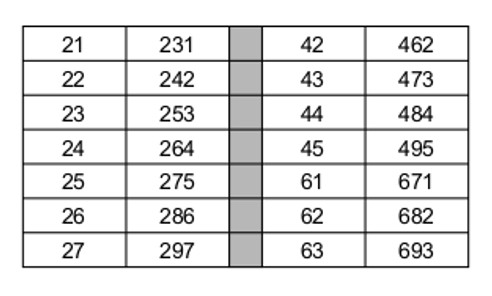
Quick! What’s 11 x 7? If that was easy for you, it is probably because you know the rule for this pattern: 11, 22, 33, 44, 55,… Just repeat the digit you’re multiplying by. This is cool by itself, especially for younger learners, but it gets better!
I introduce the 11’s game by showing off a little for my students. They have calculators in hand to check me. I tell them, “Give me any two-digit number and I will multiply it by 11 in my head.” “43!” Someone calls out. “473” I respond immediately. “52”, “572!” and the inevitable “99” “1089!”
Once they are impressed, or at least intrigued, I inform them that with the use of a simple pattern they can learn to play the 11’s game just as fast as I can.
Check out the following multiples of 11. What do you notice?
The pattern is easier to see than it is to describe, but here’s one way to put it: Take the digits of the multiplier and add them together. Put the resulting digit in between the two original digits to create your three digit product. So for 63 x 11 you add 6 + 3 to get 9 and nestle the 9 in between the 6 and the 3 to get 693.
Always start off practicing examples where the sum of the two digits of your multiplier is less than 10. Then see if you can expand the rule to allow you to deal with cases where the sum is greater than 10.
All of my tutoring that is usually done in person has had to move online for now. I find the change exhausting, but pulling this game out with one of my students had him literally shrieking with amazement and delight, giving our online tutoring session a much needed energy boost.
After enjoying the game in a purely playful spirit, I test the waters for some deeper mathematical exploration. Some students will be intrigued enough by this trick that they will want to figure out why it works. I try my best not to explain, but to instead encourage them to make sense of it for themselves. It doesn’t need to happen all at once, and patience here is rewarded with the pure delight of genuine mathematical discovery.
The Game of Nim, or “Last Pebble”
The week after the schools in my area shut down, my family went out camping on family property for a week to get away from populated areas. Even though I had my small dry erase boards with me and a Life of Fred math book, one of my favorite math games didn’t require any of those things.
One of the girls and I set about preparing for the game: We collected about 20 smallish pebbles and found a flat log to use as a playing surface. When I’m in the classroom I use base 10 block unit cubes, but you can use coins, poker chips, dried beans or any other kind of small counter or token.
The American mathematician Charles L. Bouton named the game ‘Nim’ in 1901, but it is an ancient game, no doubt played under many names, and I like to call it “Last Pebble”, “Last Coin”, or “Last Cube” depending on what we’re playing with.
To play, arrange your “pebbles” in three piles. One player gets to set up the piles, choosing the number in each starting pile, and the other player gets to decide who goes first. Players take turns removing some number of pebbles from one of the piles. You are allowed to take an entire pile if you like. You must take at least one pebble on your turn and you may not take pebbles from more than one pile on your turn. The player to take the last pebble wins.
When I’m playing with a new player I start off by trying to win about half the time. If I’m able to win by taking the final pile, I always do so, but I often will make deliberate bad moves earlier in the game to give my new opponent opportunities to beat me.
Once a new player has caught on to some of the basic strategy, I offer “puzzle mode”. We play once, with both of us trying our best to win. Having worked out quite a bit of the ideal strategy, I usually win. When I do, I will have noticed an interesting position late in the game that could be used as an instructive puzzle. Usually it’s either a game state where I knew for sure I was going to win, or where I noticed they could have won with a different move than the one they made. We return to this game state repeatedly, with the new player choosing whether to go first or second each time we replay it, until they can beat me at the puzzle.
A basic puzzle set up to try is three counters in the first pile, three in the second, and zero in the third. Again, reset the puzzle each time the player loses and have them choose again whether to go first or second. Here are some other good puzzles I use: (2, 2, 4) (1, 2, 3) (1, 3, 5).
For a deeper challenge, my students and I will try to map out ideal strategies for each player and get to the point where we can look at any starting board and be able to tell if the first or second player will ultimately win, given perfect play from both players.
Thank you for for reading. I hope you find these ideas useful and that they help bring a little mathematical silver lining into your world.
The Alexa Game is a multiplayer game I made up in which the object is to correctly predict whether Alexa (or Siri or Google) can answer a question.
Rules:
Players take turns being the Interrogator.
The Interrogator comes up with a question to ask Alexa, and makes a prediction as to whether Alexa will answer it correctly or not. The question should be written down so it can be repeated exactly.
The prediction is recorded, but not revealed to the other players until they have made their predictions.
The Interrogator reads his Alexa question to the other players without saying “Alexa”, so they can also predict the outcome.
Note: Anyone who says “Alexa”, except when directly addressing her, is deducted a point or must take a drink, or whatever.
Everyone writes down their prediction. At this point, all predictions may be shared.
Then the Interrogator says “Alexa…” and asks the question exactly as originally phrased. The players should decide whether Alexa’s response is correct. In general incorrect answers are ones where Alexa clearly misunderstood the meaning of the question, or bailed on answering it. It’s okay if Alexa reads from Wikipedia, if the reading contains the answer.
If the Interrogator guessed correctly, he gets a point for everyone who guessed incorrectly.
If the Interrogator guessed incorrectly, everyone who guessed correctly gets a point.
Note: If everyone’s prediction is in agreement, nobody will score. In this case you may optionally ask Alexa and award a point to Alexa if she defies everyone’s expectations.
The first person to reach 42 points wins.
UPDATE:
My wife finds my scoring system too complex. She’s right. Her suggestion (which also helps prevents cheating) is to not have the Interrogator make a prediction. The Interrogator just forms the question and judges the predictions of everyone else. You score if you predict right, and the Interrogator doesn’t score that turn.


 NOTE: This post was edited Jan 2nd, to reflect a modification to the settings.
 If you miss the pithy quotes, and you hate the pictures of hedgehogs and trees, you can go back to the old system. Just select the setting icon (the gear) below the puzzle, and turn on “Quotes” instead of “Pics”, as shown to the right. You can also use the “Both” setting, which will randomly alternate between quotes and pictures (using a simple coin-flip).
 In the past month I’ve published four puzzle books, you can read about them
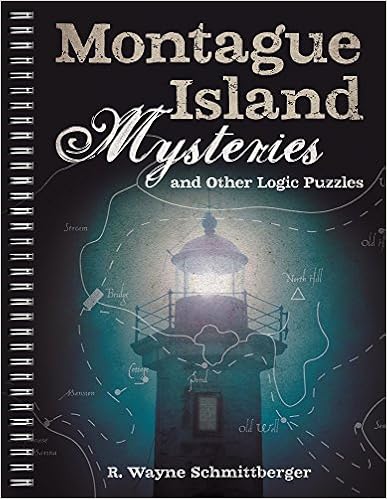
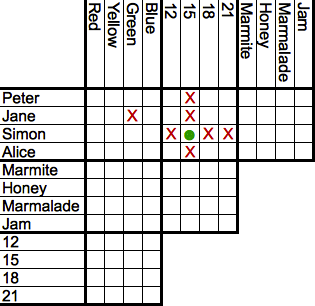 Most of these publishers tend to publish a fairly straightforward form of this puzzle, in that there is one of everything. In other words, if there are five girl scouts, then there are also five unique flavors of ice-cream, five unique sweaters, five unique merit badges and so on. These puzzles can be typically be solved on a grid which lays out all the item’s interactions, using basic inferences and the process of elimination. The puzzle is typically accompanied by a grid, like the one on the left.